Table of Contents
Understanding how to express Números Ordinais De 1 A 100 Em Inglês is essential for anyone looking to master advanced English grammar and clearly indicate position, rank, or sequence in both writing and speech.
What Are Ordinal Numbers and Why They Matter
Ordinal numbers describe the order of things in a list, telling us not just how many but which position something holds. While cardinal numbers answer "how many" (one, two, three), ordinals answer "what place" (first, second, third). Learning Números Ordinais De 1 A 100 Em Inglês allows you to talk about dates, rankings, floors of a building, or the steps in a process with precision. For example, saying "She finished in tenth place" or "We meet on the third Wednesday" relies entirely on this system. Mastering them removes ambiguity and adds sophistication to your English communication.
In English, ordinals are usually formed by adding specific suffixes to the cardinal number. The most common suffix is -th, as in "fourth" or "tenth." However, there are important exceptions for the numbers ending in one, two, and three (except for the teens). Knowing these patterns is the first step to confidently using Números Ordinais De 1 A 100 Em Inglês in everyday situations.
The Basic Patterns from 1st to 30th
The foundation of the ordinal system is built on a few key rules that apply to most numbers. For most integers, you simply add -th to the end of the cardinal number. This works for numbers like four (fourth), six (sixth), and twenty (twentieth). To write them, you use numerals followed by the appropriate letters, such as 1st, 2nd, or 3rd. Let us look at the specific exceptions for the first three numbers.
Here is a quick reference for the most common starting points:
- 1 becomes first (1st)
- 2 becomes second (2nd)
- 3 becomes third (3rd)
- 5 becomes fifth (5th)
- 8 becomes eighth (8th)
- 9 becomes ninth (9th)
- 12 becomes twelfth (12th)
Notice that numbers like "eight" drop the 't' to become "eighth," and "nine" loses its 'e' to become "ninth." These irregularities must be memorized as part of learning Números Ordinais De 1 A 100 Em Inglês.
Tackling the "Teens" and Tens
Once you pass twelve, the pattern becomes more repetitive. The numbers 13 through 19 all end with -teenth, combining the base number with the suffix. For instance, thirteen becomes thirteenth, and eighteen becomes eighteenth. Be careful with the spelling of "third" and "thirteenth," as the 'd' appears in both. When dealing with the tens (twenty, thirty, forty, etc.), you simply turn the cardinal number into its ordinal form by adding -ieth.
For the tens, the transformation follows a strict rule:
- Twenty (20) becomes twentieth (20th)
- Thirty (30) becomes thirtieth (30th)
- Forty (40) becomes fortieth (40th)
- Fifty (50) becomes fiftieth (50th)
When combining these with the units (e.g., 21, 32), you keep the final digit as a cardinal number. So 21st is "twenty-first," and 32nd is "thirty-second." This logic extends cleanly into the higher ranges of Números Ordinais De 1 A 100 Em Inglês.
Numbers 40 to 100: Applying the Rules at Scale
The beauty of the English ordinal system is its scalability. Once you know how to handle the "teens" and the "tens," you can easily construct the ordinals for the entire rest of the range. For numbers like 45, 67, or 99, you simply convert the tens and the units separately and join them with a hyphen. The tens part uses the ordinal form, while the units remain as cardinal numbers.
Consider the number 87. You break it down into eighty (cardinal) and seven (cardinal). The ordinal for eighty is "eightieth," and the unit "seven" stays as "seven." Linking them gives you "eighty-seventh" (87th). This consistent structure makes it easy to count through Números Ordinais De 1 A 100 Em Inglês without getting lost. Here are a few more complex examples to illustrate this rule:
- 44: forty-four → forty-fourth (44th)
- 56: fifty-six → fifty-sixth (56th)
- 78: seventy-eight → seventy-eighth (78th)
- 99: ninety-nine → ninety-ninth (99th)
The only exception to this hyphen rule is the number 100, which becomes "hundredth" (100th) rather than "one hundredth" when referring to the ordinal position. However, you will often hear "one hundredth" in contexts like fractions or percentages, so it is good to be familiar with both usages.
Practical Usage in Real Life Contexts
Knowing Números Ordinais De 1 A 100 Em Inglês is not just an academic exercise; it has immediate practical value. In writing, you use them for outlines (e.g., "Section 3.2") and to avoid repetition. Instead of saying "the first day, the second day, the third day," you can efficiently say "the 1st, 2nd, and 3rd days." This skill is vital for creating professional documents, academic papers, and clear instructions.
In spoken English, ordinals help you navigate the world around you. You might ask for the 23rd floor in a skyscraper, specify that the concert is on the fourth Saturday of the month, or describe a historical event that occurred in the 19th century. By internalizing the patterns of Números Ordinais De 1 A 100 Em Inglês, you remove a barrier to understanding and expressing complex information about time and hierarchy.
Common Mistakes and How to Avoid Them
Even experienced English learners sometimes stumble on ordinal numbers. A frequent error is forgetting to change the 'y' to 'i' before adding -eth for the tens. Saying "twentyth" instead of "twentieth" is a clear sign that this rule needs review. Another common slip is irregular spelling, such as writing "nineth" instead of "ninth."
To avoid these pitfalls, focus on the patterns rather than rote memorization of every single number. If you know that "twenty" becomes "twentieth" and "thirty" becomes "thirtieth," you can deduce the spelling of most other tens. For the teens, flashcards or simple repetition are the best tools to lock in the unique spellings of words like "fifteenth" and "nineteenth." Practicing the conversion of random numbers (e.g., 47, 61, 82) will build your speed and accuracy with Números Ordinais De 1 A 100 Em Inglês.
Related Videos
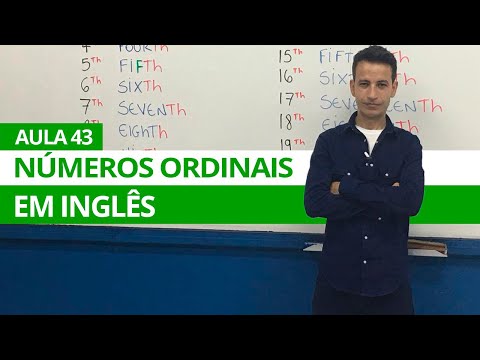
NUMERAIS ORDINAIS EM INGLÊS - AULA 43 PARA INICIANTES - PROFESSOR KENNY
Um idioma inteiro na palma da sua mão! Matricule-se já: https://www.profkenny.com.br/ Faça parte do melhor e mais completo ...
Conclusion
Mastering Números Ordinais De 1 A 100 Em Inglês unlocks a new level of fluency, allowing you to discuss dates, rankings, and sequences with confidence and precision. By understanding the core rules—the suffixes for most numbers, the exceptions for the first three, and the structure of the teens and tens—you can construct any ordinal correctly. With a little practice, these numerical tools will become a natural and effortless part of your English language skills.
%22%3E%0A%3Cstop%20offset%3D%220%22%20stop-color%3D%22%23365314%22%2F%3E%0A%3Cstop%20offset%3D%220.55%22%20stop-color%3D%22%2384cc16%22%2F%3E%0A%3Cstop%20offset%3D%221%22%20stop-color%3D%22%23bef264%22%2F%3E%0A%3C%2FlinearGradient%3E%0A%3CradialGradient%20id%3D%22r%22%20cx%3D%220.5%22%20cy%3D%220.35%22%20r%3D%220.7%22%3E%0A%3Cstop%20offset%3D%220%22%20stop-color%3D%22%23fff%22%20stop-opacity%3D%220.18%22%2F%3E%0A%3Cstop%20offset%3D%221%22%20stop-color%3D%22%23fff%22%20stop-opacity%3D%220%22%2F%3E%0A%3C%2FradialGradient%3E%0A%3C%2Fdefs%3E%0A%3Crect%20width%3D%22400%22%20height%3D%22225%22%20fill%3D%22url(%23g)%22%2F%3E%0A%3Ccircle%20cx%3D%22166%22%20cy%3D%2294%22%20r%3D%22139%22%20fill%3D%22%23bef264%22%20fill-opacity%3D%220.25%22%2F%3E%0A%3Ccircle%20cx%3D%22253%22%20cy%3D%22148%22%20r%3D%2283%22%20fill%3D%22%23365314%22%20fill-opacity%3D%220.35%22%2F%3E%0A%3Crect%20width%3D%22400%22%20height%3D%22225%22%20fill%3D%22url(%23r)%22%2F%3E%0A%3Ctext%20x%3D%22200%22%20y%3D%22155%22%20text-anchor%3D%22middle%22%20font-family%3D%22-apple-system%2CSegoe%20UI%2CRoboto%2Csans-serif%22%20font-size%3D%22170%22%20font-weight%3D%22800%22%20fill%3D%22%23fff%22%20fill-opacity%3D%220.12%22%3EC%3C%2Ftext%3E%0A%3C%2Fsvg%3E)
